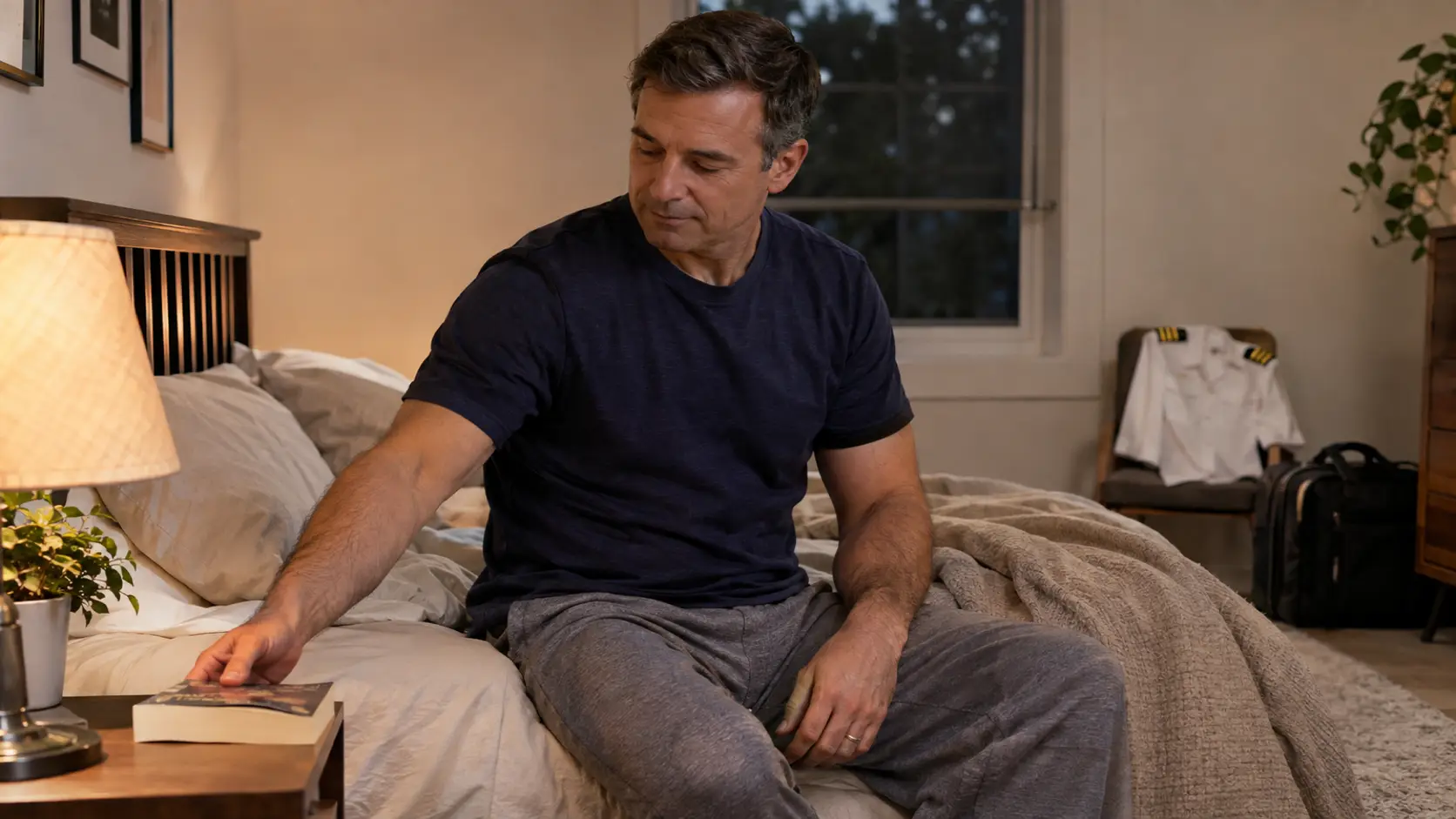
If you are a pilot who has been told you need a sleep study, your mental image is probably the traditional one: checking into a sleep lab overnight, covered in sensors, trying to fall asleep in a strange room. That has been the default for decades. But a growing number of pilots are skipping the lab entirely and testing at home instead, and the FAA is on board with it. Here is why the shift is happening and what you need to know before you choose.
The Old Default: The In-Lab Sleep Study
The traditional sleep study is a Type I study, also called in-lab polysomnography. You spend the night at a sleep center while trained staff monitor your brain activity, breathing, oxygen, heart rhythm, and movement in real time. It is thorough, and for complex cases it is still the gold standard.
The downsides for pilots are practical ones. You have to book an available lab night, which can mean a wait. You sleep in an unfamiliar environment, which does not always reflect how you actually sleep at home. And it is generally the more expensive option.
What Changed: At-Home Testing the FAA Accepts
The newer option is a Type II at-home sleep test. Modern Type II devices are worn at home and record the full clinical picture the FAA needs, not a stripped-down version. Per the FAA’s OSA Specification Sheet B, an acceptable study for FAA review is either a Type I in-lab polysomnography or a Type II (7-channel) unattended home sleep test, interpreted by a sleep medicine specialist. ESD’s studies are interpreted by a board-certified sleep medicine specialist.
That phrase, 7-channel, matters. It is part of the FAA’s standard requirements for an acceptable home sleep study. Simpler consumer-grade or basic insurance-style home tests (often Type III or Type IV) capture fewer signals, and they generally do not meet the FAA standard on their own. So the shift is not about cutting corners. It is about getting the same clinical rigor without the lab.
What the FAA Actually Requires, Regardless of Where You Test
The FAA cares about the quality and completeness of the study, not the building it happens in. Per the FAA’s OSA Specification Sheet B, the study needs to be a qualifying type (Type I or Type II 7-channel) and interpreted by a sleep medicine specialist, with a diagnosis and treatment recommendations where appropriate.
The FAA’s guidance on sleep study types reinforces the same point: qualifying testing can take place in a lab or at home.
Why Pilots Are Making the Switch
When the FAA accepts both, the decision comes down to the practical experience. Here is what pilots point to:
Convenience. You test in your own bed on your own night, with no waiting for a lab appointment to open up.
A more normal night’s sleep. Sleeping at home tends to reflect how you actually sleep, rather than how you sleep wired up in a strange room.
Cost. An at-home study is generally less expensive than an in-lab night.
Speed and control. No scheduling bottleneck at a lab means you can often get the study done and the report back sooner, which keeps your overall FAA process moving.
The same FAA standing. This is the one that makes the rest matter. A qualifying Type II study carries the same weight with the FAA as a Type I study.
When an In-Lab Study Is Still the Right Call
At-home testing is not automatically the answer for everyone. For pilots with certain complex medical pictures, or when a home study comes back unclear, a sleep physician may recommend an in-lab study to get the complete picture. The right test for your situation is a clinical decision made with a sleep specialist, not a one-size-fits-all rule.
The FAA does note a limited exception in its OSA Specification Sheet B: in communities where Type II home testing is unavailable, it accepts a Type III home study. If the result is equivocal, a higher-level test may be needed. In other words, the goal is always a clear, complete, qualifying result, whichever setting gets you there.
The Bottom Line
The reason pilots are switching is not that the rules got looser. It is that the technology caught up, and the FAA recognized it. A Type II at-home study delivers the clinical detail the FAA requires, interpreted by the same caliber of specialist, without the lab night. For most pilots, that is a clear win on convenience, comfort, and cost with nothing lost on the FAA side.
How ESD Fits In
ESD provides the Type II at-home sleep study: a 7-channel test you complete in your own home, interpreted by a board-certified sleep medicine specialist, and delivered in a report formatted for FAA review. Our role is the diagnostic study itself. We do not make certification decisions, which remain with your AME and the FAA, and we do not replace your treating physician.
If your doctor or AME has told you that you need a sleep study, and you would rather not spend a night in a lab, reach out. We are happy to walk you through what the at-home test involves and how the results fit into the FAA process.
Stay informed with Sleep Insights
Get quarterly updates for pilots on sleep testing, FAA guidance, and medical certification, plus the latest articles from Effortless Sleep Diagnostics.